
Summarize and analyze this article with
 Claude
  ChatGPT
  Perplexity
  Grok
Grok  Google AI
 Why AI Agents Need Validated Context, Not Just More Metadata
The most common diagnosis for why enterprise AI initiatives stall in 2026 is wrong. It is not that the models are weak; foundation models have rarely been better. It is not that the use cases are unclear; most enterprises have a working backlog of high-value AI applications. It is not even that the infrastructure is missing; cloud platforms, vector stores, and orchestration frameworks are widely deployed. The bottleneck is context. The agents that organizations want to put into production cannot reliably answer “should I act on this data right now,” because the context they have access to is raw metadata, not validated context.
This article explains why that distinction matters, what validated context provides that raw metadata does not, how the failure mode manifests in real AI deployments, and why the platforms that operate validated context layers are the ones AI programs will increasingly depend on.
The Raw Metadata Problem
A typical enterprise context surface in 2026 contains an enormous amount of information. Table schemas, column descriptions, business glossary terms, lineage diagrams, owner names, classification tags, freshness timestamps, query history, dbt model documentation, and a long tail of ad hoc metadata are all there. By volume, this looks like enough context to feed an AI agent.
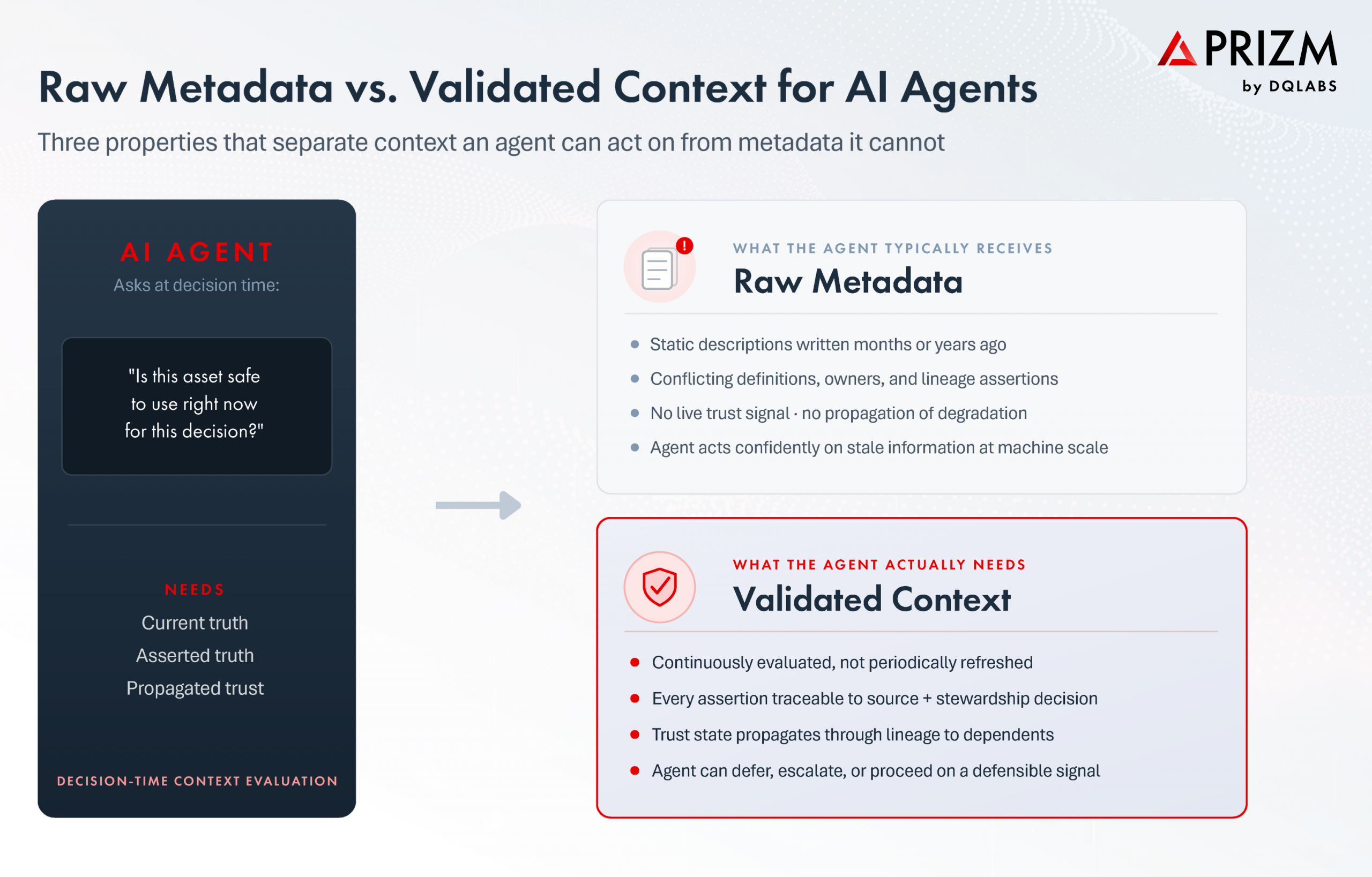
By usefulness, it is not. Three properties that AI agents actually need are absent or unreliable in raw metadata.
The first is recency. Most enterprise metadata is not refreshed continuously. Business descriptions written 18 months ago, ownership records last reviewed during the previous reorganization, and glossary terms last touched when the program launched all coexist in the same surface. The agent has no way to know which parts are current.
The second is correctness. Two definitions of the same metric in different domains, conflicting lineage assertions between the catalog and the warehouse query logs, and outdated classifications that no longer match the current policy framework are common. The agent has no way to know which assertion to trust.
The third is trust state. The metadata layer typically does not know whether the data behind any given record is currently passing its quality checks, whether the freshness SLA is intact, whether segment-level performance is degraded, or whether an upstream issue is propagating through lineage. The agent has no way to know whether the asset is safe to use at all.
When agents act on context with these gaps, they fail silently. They generate plausible answers based on stale definitions. They cite outdated owners. They reason on broken lineage. They produce confident outputs that downstream consumers later discover to be wrong, often after the wrong action has already been taken at scale.
What Validated Context Provides
Validated context is the layer that closes these gaps. It produces three properties that AI agents can actually rely on.
The first is current truth. Validated context is continuously evaluated rather than periodically refreshed. When a business definition changes, the layer captures the change, the rationale, and the approver, and the trust state of every dependent assertion updates immediately. When an owner leaves the organization, the ownership record flags as stale and routes for re-assignment. When a glossary term goes 12 months without review, it surfaces in the stewardship queue. The agent sees the current state of the layer, not the snapshot at the last refresh.
The second is asserted truth. Every claim in the layer is traceable to its source and to the stewardship decision that produced it. When two definitions of the same metric exist across domains, the layer surfaces the conflict and presents both with their respective scopes. When lineage from the catalog disagrees with computed lineage from query logs, the conflict is exposed and routed. The agent sees not only what the layer says but the confidence behind each assertion.
The third is propagated trust. Validated context propagates trust state along lineage chains. When an upstream reference table degrades, the trust state of every dependent asset adjusts automatically. When a quality metric fails on a critical dimension, the dependent dashboards, models, and AI inputs reflect the degradation immediately. The agent can read the trust state and decide to defer, escalate, or proceed based on a defensible signal.
These three properties (current truth, asserted truth, and propagated trust) are what separate validated context from raw metadata. They are also the properties that allow AI agents to operate reliably at machine scale.
The Failure Mode in Real Deployments
The cost of running AI on raw metadata is no longer theoretical. Five patterns recur across enterprise AI postmortems in 2026.
Stale-definition outputs. A customer service copilot answers a question using a metric definition that was changed three months earlier. The output is internally consistent but no longer matches the current business definition. Customer-facing communications carry the wrong number until someone notices.
Ownership routing failures. An agent escalates an issue to the documented owner, who left the organization 18 months ago. The escalation sits unattended for days. By the time it routes correctly, the incident has compounded.
Lineage hallucination. An agent reasons about the upstream of a critical asset using documented lineage that no longer matches the computed lineage. The reasoning is plausible but incorrect, and downstream remediation actions are taken against the wrong upstream cause.
Silent quality degradation. An AI input data product has been failing its segment-level quality checks for two weeks. The agent has no visibility into the quality state and continues to produce outputs that are reliably accurate on average but unacceptably wrong for specific customer segments. The bias surface is detected by an external audit rather than by the platform.
Policy bypass. A document intake agent ingests a document that should have triggered a data residency restriction. The classification was missing from the metadata. The agent acts, and the breach is discovered later by compliance.
Each of these failures has the same root cause: the agent acted on raw metadata when it needed validated context. None of them is a model problem. All of them are a context problem.
Why More Metadata Is Not the Answer
A natural response to these failures is to add more metadata. Better glossaries, more documentation, richer lineage, additional ownership fields. This response misses the point. The problem is not that the layer is too thin; the problem is that the layer is not validated.
Adding more metadata to a layer that is not continuously validated produces a layer that is larger and equally unreliable. Consumers and AI agents do not need more text. They need fewer assertions, each of them currently true, traceable to a source, propagated through lineage, and exposed at decision time.
The platforms that recognize this are the ones moving the category forward. The platforms that respond to AI demands by shipping more enrichment features are extending the active metadata generation past its useful life.
What Validated Context Costs to Operate
Operating a validated context layer is more demanding than operating a raw metadata layer. Three operating practices are non-negotiable.
The first is continuous integration with data quality and observability signals. The layer cannot be validated in isolation. It has to absorb the results of autonomous quality metrics, alert clustering, freshness monitoring, schema drift detection, and segment-level analysis as they happen. Programs that treat context, quality, and observability as separate workstreams cannot produce validated context, because the signals do not flow into the layer at the rate the layer needs to be reassessed.
The second is stewardship at runtime. Validated context requires a stewardship function that operates continuously, with autonomy modes that distinguish between actions the platform can take alone, actions that require human approval, and actions that are fully manual. A quarterly stewardship committee cannot keep pace with a context layer that needs to update by the hour.
The third is exposure where decisions happen. The layer has to be readable by AI agents in the surfaces they already use. MCP and equivalent protocols are now the baseline expectation for making the context layer reachable by Claude, Microsoft Copilot, and other AI tools. A context layer that lives only in a portal is operationally invisible to agentic systems.
The platforms that have been built around this operating model from the architecture up deliver validated context. The platforms that retrofit it produce dashboards that look similar but do not survive the agent workload.
Where Prizm Fits
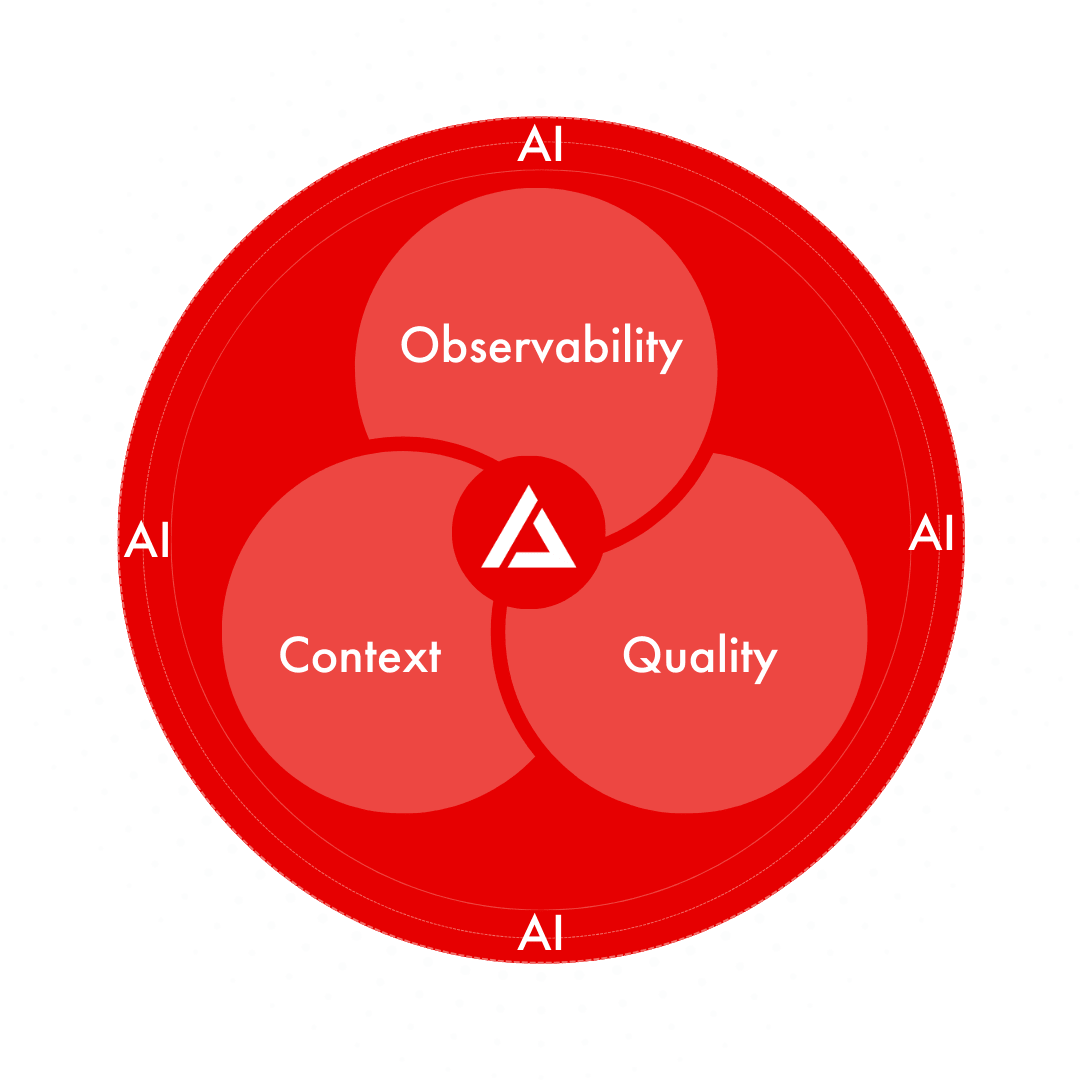
Prizm by DQLabs is purpose-built for the validated context use case. DQLabs publicly positions Prizm as an AI-native platform where data observability, data quality, and context work together as one system, and the validated context layer emerges directly from that integration.
Prizm captures context across the seven layers that matter (semantic, operational, governance, quality, usage, human, and business), validates it continuously through autonomous metric deployment, alert clustering, segment analysis, reconciliation, and stewardship logging, and exposes it in the surfaces where decisions happen, including BI tools, the Converse Engine, and MCP for external AI tools. Trust state propagates across lineage so a degradation upstream immediately shows up in the trust signal exposed to the downstream consumer or agent.
The architecture matters. It is the difference between an agent that can ask “is this safe to use right now” and get a defensible answer with the evidence behind it, and an agent that asks the question and receives an outdated description with no current trust signal attached. The first agent reaches production. The second one stalls at the trust gate, regardless of how good the model is.
The Strategic Takeaway
Enterprise AI programs in 2026 do not need better models. They need better context. The path from pilot to production runs through the layer that can vouch for the meaning, accountability, and current trust state of the data the agent is consuming. That layer is the validated context layer, and the platforms that operate it are the foundation the next phase of enterprise AI will be built on.
The buyers who recognize this and architect against it will see their agents reach production reliably. The buyers who continue to add metadata in the hope that volume will solve quality problems will continue to investigate why their AI initiatives stall. The difference is no longer about features; it is about whether the context layer can be trusted.
Frequently Asked Questions
Why do AI agents need validated context instead of raw metadata?
Raw metadata contains stale definitions, conflicting assertions, and no trust signal. AI agents acting on raw metadata fail silently and produce confident but wrong outputs. Validated context provides current truth, asserted truth, and propagated trust, which are the properties agents actually need to act reliably.
What is the difference between metadata and validated context?
Metadata is descriptive information about data. Validated context is metadata that has been continuously evaluated for currency, accuracy, and completeness, with trust signals propagated along lineage and exposed where decisions happen. Volume is not the difference; validation is.
Can you fix an AI program by adding more metadata?
No. Adding more metadata to a layer that is not validated produces a larger and equally unreliable layer. Programs that fix AI reliability issues do so by integrating quality, observability, and context into a single system that produces validated context.
How does Prizm by DQLabs deliver validated context?
Prizm operates context, observability, and quality as one system. It captures context across semantic, operational, governance, quality, usage, human, and business layers, validates it continuously through autonomous metrics and stewardship logging, and exposes it through BI surfaces, the Converse Engine, and MCP for external AI tools.
What does it cost operationally to maintain validated context?
The cost is in the operating model, not the headcount. Validated context requires continuous integration with quality and observability signals, stewardship that operates at runtime, and exposure of the layer where decisions happen. Platforms that absorb these requirements from the architecture deliver the layer without expanding the team.
Why are AI initiatives stalling in 2026 on context rather than on models?
Foundation models are stronger than ever; the bottleneck has moved upstream. Agents in production need a reliable signal for whether to act on data, and that signal can only come from a validated context layer. Programs without that layer stall at the trust gate regardless of model quality.