
Summarize and analyze this article with
 Claude
  ChatGPT
  Perplexity
  Grok
Grok  Google AI
 How to Evaluate Data Observability Tools: A Buyer’s Framework
Most data observability evaluations end up at the same outcome regardless of which tools were on the shortlist: the team buys the platform whose demo was sharpest, justifies the choice with the criteria the chosen platform happens to score well on, and discovers the meaningful trade-offs six months into deployment. The category has matured to the point where this approach has stopped being acceptable. The platforms differ in ways that matter to enterprise operating models, and the cost of a poor selection — measured in stalled programs, abandoned tooling, and slipped AI initiatives — is now too high to defend on demo polish alone. This article provides a buyer’s framework that separates the criteria that actually predict deployment success from the noise. It is written for the data leaders, platform owners, and procurement partners who have to defend a selection against scrutiny twelve months later.
The Premise
The right framework starts from one observation: the differences between leading data observability platforms in 2026 are not primarily about feature presence. Most platforms can monitor freshness, detect schema drift, render lineage, and fire alerts. The differences are about how those capabilities are delivered, automated, prioritized, and exposed — and about the architectural decisions that determine whether the platform scales gracefully to the size of the modern enterprise data estate. A good framework therefore evaluates capability depth more than capability presence, automation more than configuration, integration more than feature count, and operating model more than UI gloss.
The Eight Evaluation Dimensions That Matter
The criteria below are the ones that consistently differentiate platforms in enterprise selection. Each is best assessed through scenario-based walkthroughs against real prospect data, not through marketing collateral.
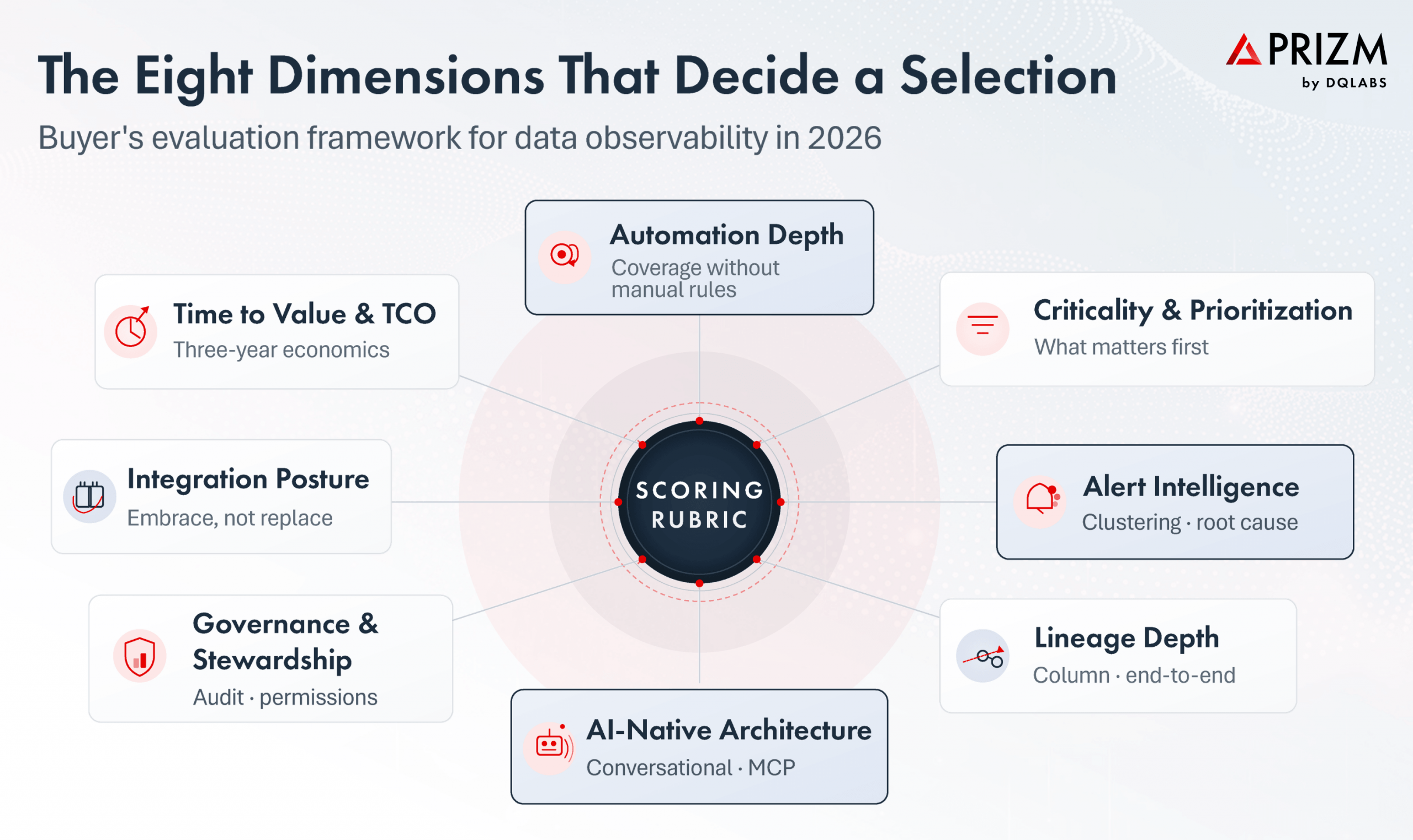
The criteria below are the ones that consistently differentiate platforms in enterprise selection. Each is best assessed through scenario-based walkthroughs against real prospect data, not through marketing collateral.
Automation Depth
The first dimension is how much of the operational workload the platform absorbs automatically. Specific questions: does the platform deploy baseline metrics automatically when a source is connected, or does it require manual rule authoring? Are profiling decisions and depth automated based on asset criticality? Does the platform recommend or generate business quality checks with AI, or expect every check to be written by a steward? This dimension matters because the asset volumes in a modern enterprise estate make hand-authored coverage impossible. Platforms that lean on AI-native automation deliver coverage that legacy tools cannot match at the same headcount.
Criticality and Prioritization
The second dimension is how the platform decides what to monitor first and how deeply. Specific questions: is there a criticality engine that scores assets automatically? What signals feed the score (usage, lineage, governance, operational, downstream consumption)? Can the score be overridden? Does downstream platform behavior — profiling depth, metric deployment, alert priority — actually key off the score? This dimension matters because uniform coverage across assets with different business importance is the largest source of wasted observability spend.
Alert Intelligence
The third dimension is how the platform handles alert volume. Specific questions: does the platform cluster related alerts to a single root cause? Is there a propagation timeline showing how an upstream issue cascaded? Does it suppress alerts for self-healing pipelines? Is remediation guidance focused on root cause or symptom? This dimension matters because alert noise is the leading reason engineering teams disengage from observability platforms after the initial rollout.
Lineage Depth and Coverage
The fourth dimension is end-to-end lineage. Specific questions: does the platform capture lineage at the column level, not just the table level? Does it span ingestion, transformation, warehouse, and BI layers? Can it reach into dbt, Airflow, semantic layers, and downstream reports? Is lineage computed from query logs and code, ingested from native catalogs, or both? This dimension matters because every downstream capability — alert clustering, impact analysis, trust propagation, criticality scoring — depends on lineage accuracy.
AI Native vs AI Layered
The fifth dimension is whether the platform was designed around AI or had AI added later. Specific questions: is there a conversational interface that covers discovery, investigation, recommendation, and remediation? Does it support natural language across the platform’s full surface area? Is there MCP-native integration with external AI tools? Are the underlying agents true autonomous components or chatbot wrappers around an existing rules engine? This dimension matters because the platforms that are AI-native from the architecture up consistently deliver more capability per dollar than the platforms that retrofitted AI as a feature.
Governance and Stewardship
The sixth dimension is whether the platform is deployable in regulated environments. Specific questions: how granular is the permission model (look for 200+ control points)? Is there a stewardship panel that categorizes platform actions by autonomy mode? Is every AI action logged and auditable? Can autonomous actions be rejected or overridden? Does the data ever leave the customer environment, or only the metadata? This dimension matters because autonomous operation without auditability is a non-starter in financial services, healthcare, public sector, and regulated industries.
Integration Posture
The seventh dimension is whether the platform embraces or replaces existing tooling. Specific questions: does it integrate natively with existing catalogs (Microsoft Purview, Collibra, Atlan, Alation)? Does it integrate with BI tools (Tableau, Power BI, Sigma, Domo, Looker)? Does it expose APIs and MCP for external systems? Does it require the team to migrate away from working tools? This dimension matters because catalog and governance investments are sticky. Platforms that demand rip-and-replace face longer adoption curves and more pushback from stakeholders who have already invested elsewhere.
Time to Value and Cost Posture
The eighth dimension is operational economics. Specific questions: what is the realistic time from initial source connection to baseline coverage? What does the AI consumption model look like (some platforms charge by token, others include unlimited tokens for an initial period)? How does pricing scale with asset volume, source count, and user count? What does total cost of ownership look like in years two and three, not just year one? This dimension matters because most enterprise selections that look attractive on year-one pricing become problematic on year-three pricing as scale increases.
The Criteria That Don’t Matter as Much as They Look
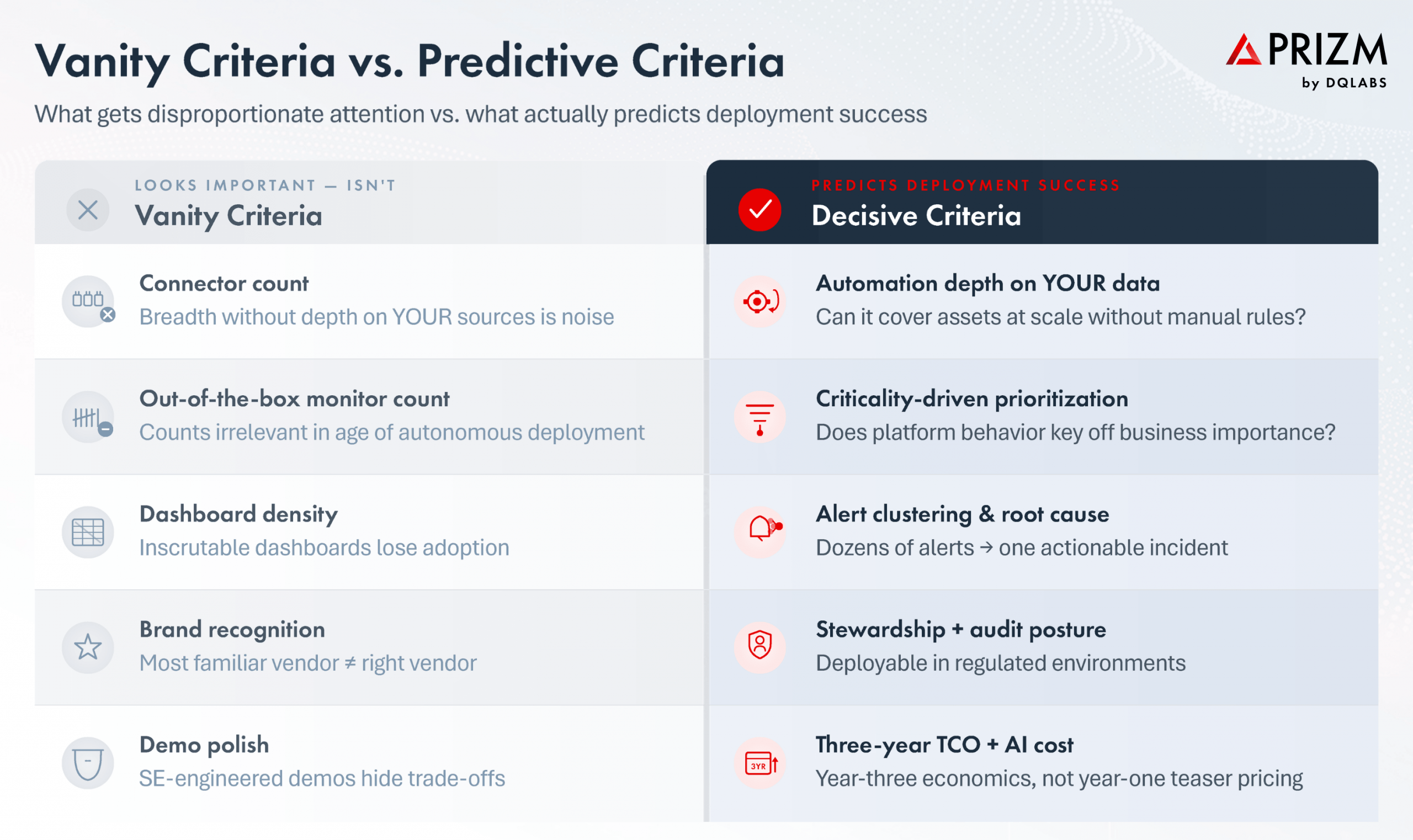
Several dimensions get disproportionate attention in evaluations relative to their predictive power. The size of the connector library matters less than the depth and reliability of the connectors you actually need. A platform with 60 connectors that misses your treasury system is worse than a platform with 25 connectors that covers it well. The number of out-of-the-box monitors matters less than how well the platform discovers what to monitor. Counting monitors is a vanity metric in the age of autonomous metric deployment. Dashboard density matters less than dashboard relevance. Platforms with extensive but inscrutable dashboards lose adoption to platforms with fewer, more useful surfaces. Brand recognition matters less than fit. The most familiar vendor is not automatically the right one, and several of the most capable platforms in 2026 are not the ones that appear most often in industry press.
A Scoring Model
A defensible scoring model assigns weights to the dimensions above based on organizational priorities, scores each platform against scenario-based evaluation criteria, and produces a composite ranking. The weights matter. A regulated enterprise should over-weight governance, lineage, and stewardship. An AI-heavy organization should over-weight automation depth, AI-native architecture, and integration with external AI tools. A team buried in alert noise should over-weight alert intelligence. A useful pattern is to define five to seven evaluation scenarios drawn from actual operational pain — investigate a specific recurring incident, demonstrate root cause on a real lineage chain, generate a business quality check from a real domain prompt, expose a trust signal in a BI tool, audit an autonomous action — and score each platform on how well it handles each scenario with real prospect data. Generic demos tell you less than a scenario walkthrough.
Trap Categories to Watch For
A few categories of risk consistently undermine enterprise evaluations. Platforms that demo well on small, clean datasets and degrade at enterprise scale. Always test against a realistic data volume during a proof of value. Platforms whose roadmap depends on capabilities that have not shipped. Evaluate what is live today, not what will ship next quarter, while keeping roadmap as a tiebreaker. Platforms with strong individual features but weak integration to the rest of the data stack. Strong observability that lives in a silo is worse than mediocre observability that integrates. Platforms with opaque pricing or aggressive token-based pricing that introduces budget uncertainty. Insist on a clear total cost picture across at least three years. Platforms with weak audit and stewardship layers, regardless of how attractive the rest of the feature set is. Without auditability, regulated industries cannot deploy.
Where Prizm by DQLabs Tends to Score Well
In enterprise evaluations against this framework, AI-native platforms designed around the patterns above tend to outscore platforms built on earlier-generation rules engines. Prizm by DQLabs is a current example. It scores particularly well on automation depth (autonomous metric deployment across operational, performance, and quality dimensions), criticality and prioritization (a personalized criticality engine that drives downstream platform behavior), alert intelligence (alert clustering with propagation timelines and root-cause analysis), governance (a stewardship panel with four autonomy modes and 273 granular permission points), integration posture (an explicit embrace-and-enhance position with native MCP for AI tools and APIs for everything else), and cost posture (an accessible enterprise price point with unlimited AI tokens in the first year). The point is not that Prizm wins every evaluation. The point is that evaluations conducted against the dimensions that actually predict deployment success — rather than feature checklists — tend to surface platforms with this profile.
Final Word
A good evaluation framework is shorter than most evaluation rubrics, weighted more heavily toward operating model than feature count, and grounded in scenario-based testing against real prospect data. The teams that defend their selection two years later are the ones who chose against a framework like this, and who can articulate not just what they bought but what trade-offs they accepted and why. The cost of a strong evaluation discipline is a few weeks of additional rigor. The cost of skipping it is measured in slipped AI initiatives and shelfware. A final practical note. Vendor-driven evaluations have grown sharper in 2026, with prepared scripts, prepared data, and prepared answers to the questions buyers most often ask. The countermove is to write the rubric privately, refuse to share it before the engagement, and reserve the right to redirect the demo into scenarios drawn from the team’s own backlog. Vendors will adapt. The ones that adapt cleanly are usually the ones worth shortlisting, and the ones that resist are usually the ones who will struggle when the platform meets enterprise scale.
Frequently Asked Questions
What are the most important criteria for evaluating a data observability tool?
Automation depth, criticality and prioritization, alert intelligence, lineage depth, AI-native architecture, governance and stewardship, integration posture, and time to value with cost. These eight dimensions predict deployment success more reliably than feature counts.
Why does criticality scoring matter so much in a buyer’s framework?
Because asset volumes in modern enterprises make uniform coverage uneconomical. Platforms with a criticality engine that scores assets automatically and drives downstream platform behavior deliver better outcomes per dollar than platforms that treat all assets equally.
How should AI capabilities be evaluated?
By looking at architectural depth, not feature presence. A conversational interface that covers discovery, investigation, recommendation, and remediation is meaningfully different from a chatbot bolted to a rules engine. MCP integration with external AI tools is now a baseline expectation in enterprise selections.
What is the most common evaluation mistake?
Optimizing for demo polish and feature counts instead of the operating model. Most platforms can demo most capabilities. Few can sustain them at enterprise scale with sound governance, integration, and economics.
How should an enterprise scope a proof of value?
Five to seven scenarios drawn from real operational pain, scored against the eight dimensions in this framework, using real prospect data at realistic volume over a defined window (typically six to eight weeks). Demos do not substitute.
How does Prizm by DQLabs perform against this framework?
Prizm scores well across automation depth, criticality scoring, alert intelligence, governance, integration posture, and cost — the dimensions that distinguish AI-native platforms in 2026. It is one of the platforms that consistently surfaces in enterprise selections conducted against a discipline like the one described here.