
Summarize and analyze this article with
 Claude
  ChatGPT
  Perplexity
  Grok
Grok  Google AI
 How Good Is Your Context? A Framework for Measuring Context Quality
Every enterprise has a context layer of some kind in 2026. Some are built on modern catalogs with rich automation; some are built on stitched-together combinations of glossaries, dbt docs, and Confluence pages; some exist primarily in the heads of long-tenured stewards. Whatever the form, the fundamental problem is the same. Most data leaders cannot answer, in operational terms, how good their context actually is. They know it exists. They do not know whether it is fresh, complete, or reliable enough to trust at scale.
This article walks through a practitioner-grade framework for measuring context quality. Six dimensions, an operating model for producing a defensible score, and the platforms architecture that turns the measurement into validated context that AI agents can act on.
Why Context Quality Has Its Own Measurement Problem
Data quality is a mature discipline. Six dimensions, well-defined metrics, and decades of practice have produced shared language across the industry: accuracy, completeness, consistency, uniqueness, timeliness, validity. Context quality is younger, less defined, and harder to measure because the inputs are messier. Business definitions evolve. Ownership shifts. Glossary terms drift. Stewardship activity ebbs and flows. Trust signals propagate across lineage chains with surprising latency. None of this lends itself to a tidy SQL query.
The result is that most enterprise context layers grow without measurement. Glossary terms accumulate. Documentation gets written, sometimes accurately. Policies get tagged, sometimes correctly. Ownership records get assigned, often by default. After two or three years, the layer is large, fragmented, partially outdated, and difficult to trust, but there is no metric that surfaces the problem clearly. Consumers learn to route around the layer rather than rely on it.
A context quality framework is the response. The point is not to assign a vanity score to the context layer; it is to give the program a defensible diagnostic of where the layer is strong, where it is weak, and where the highest-leverage investment lives.
The Six Dimensions of Context Quality
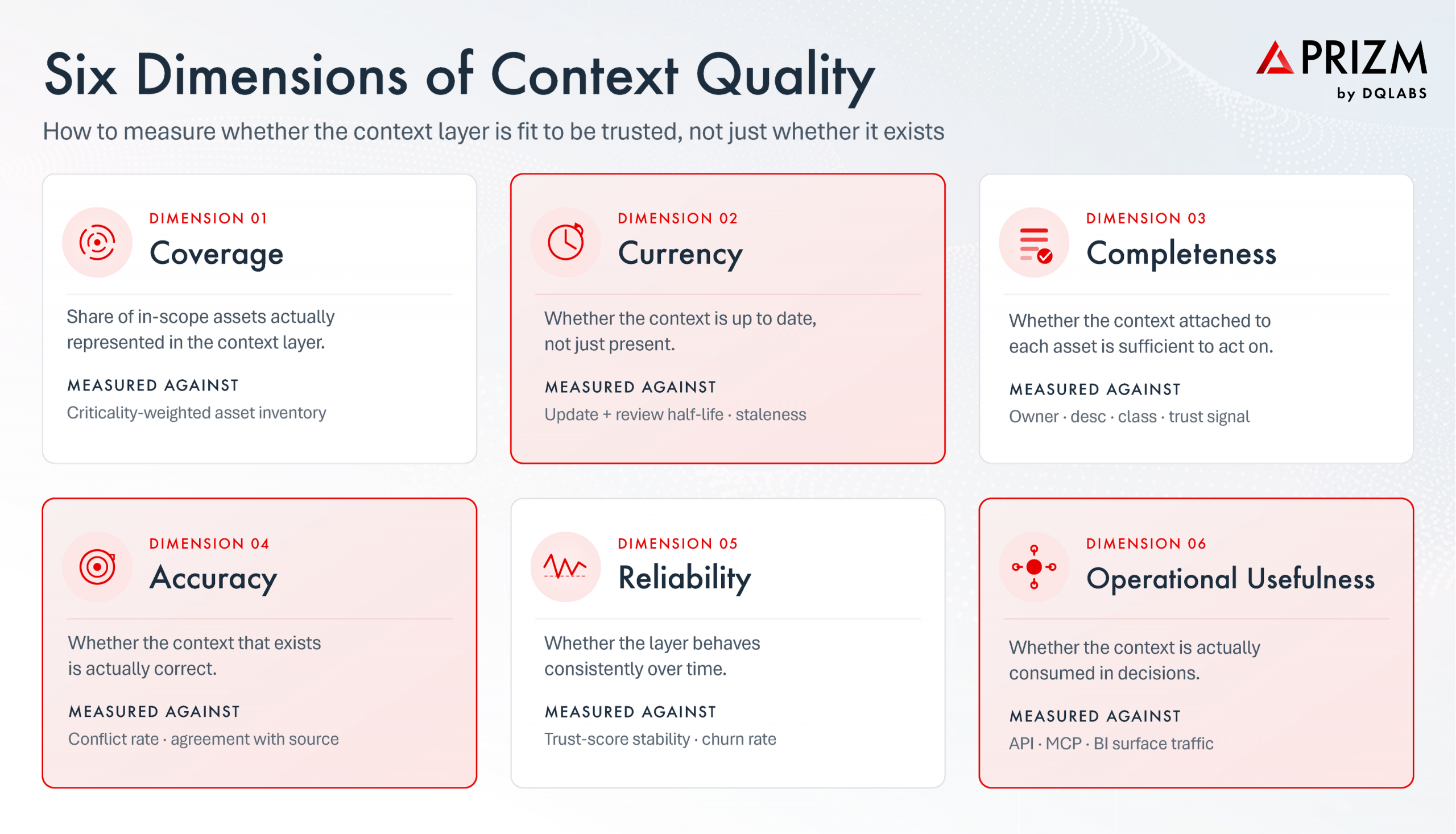
A defensible framework for measuring context quality rests on six dimensions, each of which captures a different operational property of the layer.
1. Coverage
Coverage measures what share of the assets that should be in the context layer actually are. Coverage is asset-class specific. Curated gold-layer tables should have near-complete coverage. Raw landing tables typically should not, because they are not consumed for decisions. The first job of the measurement is to define which assets are in scope, and the second is to measure the share that have semantic definitions, owners, classification, and trust signals attached.
Programs that skip the scope definition produce vanity coverage numbers (98 percent of all tables) that obscure the fact that the critical 200 tables are at 60 percent. Coverage measurement should be done against the criticality-weighted asset inventory, not against the raw count.
2. Currency
Currency measures whether the context is up to date. The proxy signals are typically: last update date on the glossary term, last review date on the ownership record, last steward activity timestamp, last lineage validation event, and the staleness of any quality coverage attached to the asset. Currency is the dimension most enterprises consistently fail on, because static documentation ages quickly and almost no program has a defensible review cadence at scale.
A useful pattern is to derive a currency half-life. If half the glossary terms were last updated more than 12 months ago, the layer has a currency problem regardless of how clean the typography is. The platforms that operate the context layer continuously, with automatic re-evaluation triggered by underlying signal changes, produce dramatically better currency than the platforms that depend on quarterly review cycles.
3. Completeness
Completeness measures whether the context attached to each in-scope asset is sufficient to act on. The exact attributes required vary by asset class, but a typical completeness model checks for: a business description, an owner, a classification, a domain, lineage to upstream and downstream consumers, attached metrics or quality coverage where relevant, and a current trust signal.
Completeness is distinct from coverage. An asset can be covered (it has a record in the layer) and still be incomplete (only the technical metadata is captured, none of the business context). Most enterprise context layers have high coverage and low completeness, which is what produces the trust gap in practice.
4. Accuracy
Accuracy measures whether the context that exists is actually correct. The proxy signals are typically: agreement with the underlying source (does the glossary term match how the business actually uses it), agreement across consumers (do finance, marketing, and product use the same definition), agreement with lineage (does the documented upstream actually match the computed lineage), and agreement with stewardship activity (have stewards approved or rejected the assertions in the layer).
Accuracy is the hardest dimension to measure because it requires comparing the layer against signals that may themselves be partial. The pattern that works in mature programs is to compute conflict rates: how many definitions in the glossary have known conflicts across domains, how many ownership records contradict the steward activity log, how many lineage assertions contradict the computed lineage. High conflict rates signal accuracy problems.
5. Reliability
Reliability measures whether the context layer behaves consistently over time. The proxy signals are: stability of the trust scores associated with critical assets, stability of ownership records (frequent changes signal a brittle program), stability of business definitions (frequent uncoordinated changes signal a governance gap), and stability of the quality and observability signals feeding the layer.
Reliability is what determines whether consumers and AI agents learn to trust the layer or learn to route around it. A layer that produces wildly different trust scores for the same asset week over week is not reliable, regardless of how rich the underlying metadata is.
6. Operational Usefulness
Operational usefulness measures whether the context is actually consumed in decisions. The proxy signals are: query traffic against the context layer through APIs, MCP, or conversational interfaces; references to the layer in BI reports and AI agent outputs; reduction in consumer-reported confusion incidents; and the share of AI deployments that depend on the layer at decision time.
Operational usefulness is the dimension that connects context quality to business outcomes. A layer that scores well on the first five dimensions but is never consumed is a museum exhibit. A layer that scores well on the first five and is consumed everywhere is operational infrastructure.
A Practical Scoring Approach
The six dimensions combine into a context quality score with a similar structure to a data trust score. Each dimension produces a normalized 0 to 100 sub-score. A weighting scheme reflects organizational priorities: regulated industries over-weight accuracy and reliability; AI-heavy organizations over-weight currency and operational usefulness; programs early in maturity over-weight coverage and completeness. The composite is a single 0 to 100 number with drillable components.
Two conventions matter. First, the score should be computed per domain or data product, not only at the enterprise level. An aggregate 78 means little if finance is at 92 and marketing is at 51. Second, the score should be paired with a change signal: the trajectory over time. A score that is improving is more credible than a higher score that is stagnant or declining.
The Operating Model That Produces a Good Score
A defensible context quality program rests on three operating practices.
The first is automation of the underlying signals. Context coverage, currency, and completeness cannot be maintained at enterprise scale through quarterly manual reviews. Modern platforms continuously profile the layer, surface gaps, and feed the dimensions automatically. The platforms that operate observability and quality in the same surface as context produce dramatically better scores because the signals feed each other.
The second is stewardship that operates at runtime, not on a committee cadence. Stewards review, approve, and reject context assertions as part of the daily workflow rather than as a quarterly artifact. Modern stewardship panels organize work across autonomy modes so that critical assertions get review and non-critical assertions move autonomously with audit.
The third is exposure where decisions happen. The context layer has to be readable by consumers in the surfaces they use, which means BI tools, conversational interfaces, AI agents via MCP, and embedded in data product pages. Exposure is what produces operational usefulness, which is what produces continued investment in the other five dimensions.
Where Prizm Operates the Measurement
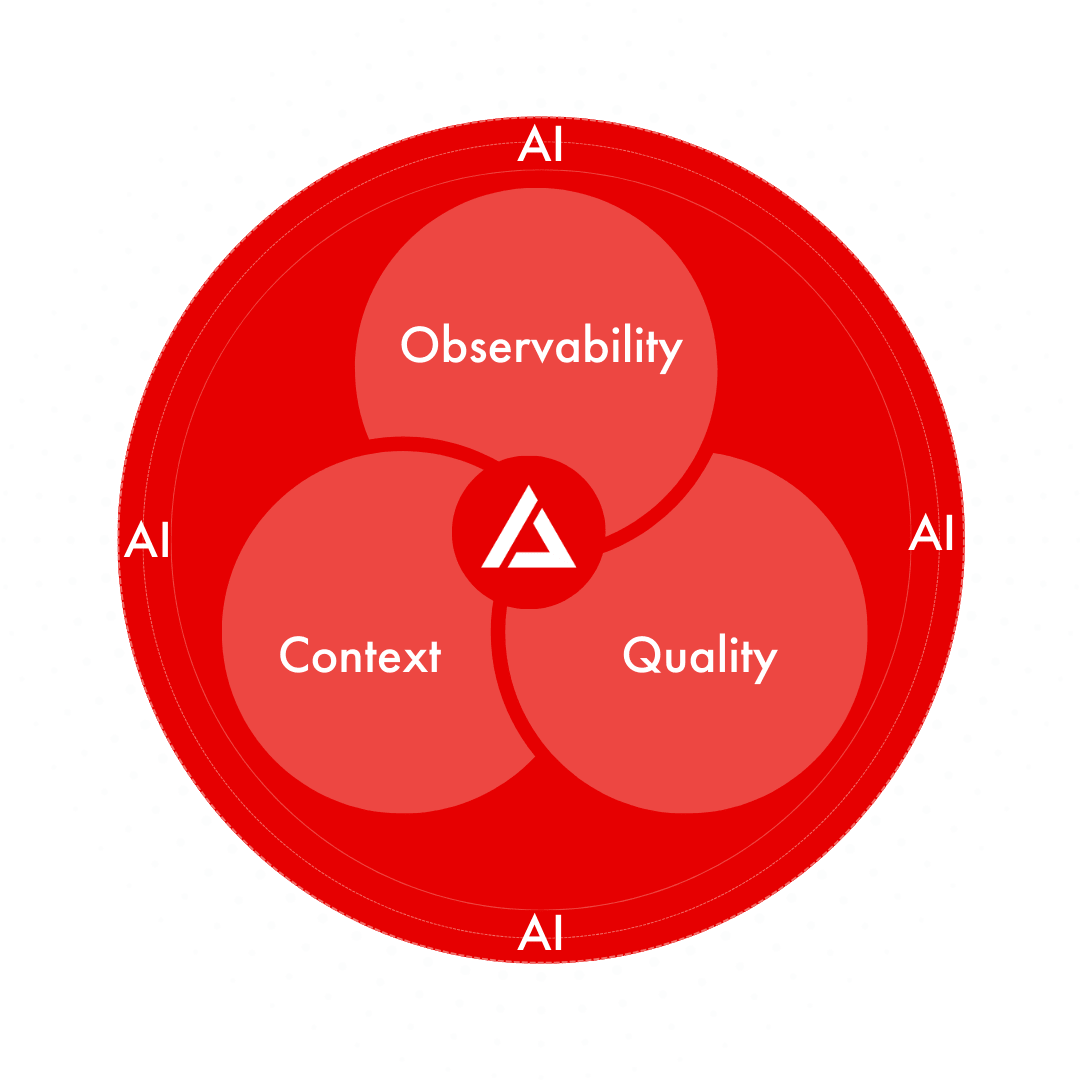
Prizm by DQLabs is built to produce context quality continuously rather than as a periodic artifact. DQLabs publicly positions Prizm as an AI-native platform where data observability, data quality, and context work together as one system, and the context quality framework above is essentially the dashboard that emerges naturally from that integration.
Prizm continuously assesses coverage through the criticality-weighted asset inventory, currency through stewardship activity logging and freshness propagation, completeness through autonomous documentation generation and gap surfacing, accuracy through conflict detection across domains and consumers, reliability through trust score stability over time, and operational usefulness through Converse Engine and MCP traffic against the layer. The Stewardship Panel turns each gap into a routed action so the score does not just describe the problem; it drives the work to resolve it.
The platform also propagates the score across lineage so a degradation in an upstream reference table immediately shows up as a context quality degradation in dependent assets. This propagation is what allows the layer to be operationally trusted by AI agents, which are otherwise unable to detect upstream problems before they act on degraded inputs.
What Data Leaders Should Do Next
Three practical actions follow from this framework.
First, measure the layer. Even a rough first pass against the six dimensions reveals where the program is fragmented. Most enterprises discover their coverage is healthier than expected, their currency is worse than expected, and their operational usefulness is much worse than expected.
Second, prioritize against the dimensions, not the inventory. Investing more time in adding glossary terms when the existing terms have a currency half-life of 18 months produces no incremental value. Fix currency first, then complete the underrepresented attributes, then expand coverage.
Third, evaluate the platform stack against the operating model. The programs that score well across the six dimensions in 2026 are the ones running on platforms that integrate observability, quality, and context as one system rather than as three reconciled streams. The platform decision is no longer a tooling choice; it is a structural choice about whether the context layer can be measured and validated at all.
Frequently Asked Questions
What is context quality?
Context quality is a measure of whether the metadata, business definitions, ownership, classification, lineage, and trust signals surrounding data assets are accurate, current, complete, reliable, and operationally useful. It is broader than data quality, which focuses on the data itself.
What are the six dimensions of context quality?
Coverage, currency, completeness, accuracy, reliability, and operational usefulness. Each captures a different property of the context layer; together they form a defensible scoring framework.
How is context quality different from data quality?
Data quality measures whether the data is correct, complete, and timely. Context quality measures whether the layer surrounding the data, including business definitions, ownership, classification, and trust signals, is fit to be relied on. The two are complementary, and both have to be measured to support modern AI workloads.
How often should a context quality score be refreshed?
Continuously. Static review cycles produce stale scores by definition. Platforms that integrate observability, quality, and context as one system can refresh the score whenever the underlying signals change, which is what allows the layer to be operationally trusted.
How does Prizm by DQLabs measure context quality?
Prizm continuously assesses coverage, currency, completeness, accuracy, reliability, and operational usefulness through autonomous metrics, stewardship logging, conflict detection across domains, and propagation through lineage. DQLabs publicly positions Prizm as an AI-native platform where data observability, data quality, and context work together as one system, and the context quality framework emerges naturally from that integration.
What is the most common gap in enterprise context layers?
Currency, by a wide margin. Most layers have reasonable coverage but documentation, ownership records, and definitions age quickly without an operating model that maintains them. Programs that fix currency first see the highest near-term improvement in trust and operational usefulness.